

Personal Protective Equipment (PPE) encompasses a wide range of products, and many of the most common and useful are in the low tech category, such as the humble hard hat or face mask. Such products are low cost and effective. However technology based solutions are supplementing simple physical protection to an increasing degree.
In the developed world at least, our tolerance of risk is reducing and expectations of worker safety increasing. At the same time our use of tools and machinery to enhance productivity can introduce new dangers to workplaces. Aside from the human cost of a workplace accident and injury, there is a hard economic factor via absence costs, lost productivity and potential liabilities in the face of stricter legislation. Hence the drive to incorporate technology into PPE solutions in order to protect against a wider range of risks.
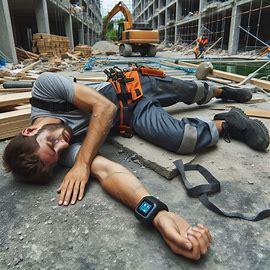
Wearable Devices
We have become familiar with consumer wearable devices that act as health and fitness trackers for sports enthusiasts or just for people interested in their overall wellbeing. The basic concept of such a device can be adapted to suit a workplace safety use case.
The key difference is that for a PPE oriented device, rather than simply provide data to the user, it would typically be connected to some kind of management system in order to alert supervisors of any incident. Applications of this type could include
- “Person down” detector, which would identify a fall, or a motionless worker and trigger an intervention
- Physiological markers, such as heat, or hydration levels to indicate when a worker would need rest or water, something that will become more necessary with increasing temperatures
- Gas or pollutant detection, in cases where there are risks from hazardous materials.
Depending on the use case, for some it might be sufficient to alert the user, or it may be necessary to provide a real time alert to a supervisor. In the case of a large site, it might also be necessary to provide a location for the affected user so they could be quickly found and assisted.
Wireless Technologies
The next issue to look at is what kind of devices and with what kind of wireless technologies might be required to deliver the above applications?
The cases where physiological data is collected typically require skin contact, so some kind of patch or wristband device would be an obvious solution. Others such as environmental sensing may not need this, but in nearly all cases, the device would require wireless connections to allow the worker to carry out their tasks unimpeded.
In terms of connecting the device to other systems, there are a number of options, depending on the characteristics of the work site. The key questions would be
- Is the site indoors or outdoors
- Is there good cellular coverage (not necessarily the case indoors, or underground)
- Is there good coverage via WiFi, or some other local network across the site?
It might be enough for the device to connect via Bluetooth to a mobile phone, which can then handle such tasks as localization; however this approach relies on the worker carrying their phone at all times (and keeping it charged!). Alternatively, the device could connect to a WiFi network if one is available. Localization could be achieved via GPS in most outdoor settings, but this stops working in most indoor situations and certainly in anything underground. In such cases, a system for localization would have to be installed, which could use WiFi access points, Bluetooth beacons or the new channel sounding technology, or Ultra-Wide Band. Which to use depends on how accurate the localization needs to be and how important it is to always be in coverage. Normally a moderately accurate solution would be enough to locate an injured worker, and could be achieved via Bluetooth or WiFi, but the best precision would be obtained using Ultra Wide Band. In all cases, such solutions would require an infrastructure of Anchor Point devices in known locations, which may be a non-trivial issue in a fast changing environment such as a construction site .
Indoor or underground working environments.
For sites where cellular coverage is not realistic, such as underground, or inside large structures, and there isn’t a network infrastructure in place, LoRa technology could be a good solution for a device to communicate with a central system. LoRa allows the setting up of a private network with long range, and provides good connectivity even in challenging environments. Adaptive data rate technology is built into the LoRa encoding scheme, which allows a dynamic trade off between range and data rate, so devices can remain connected even if there are significant obstacles between the device and the central system. A single gateway can cover a large area of up to 10 km, depending on the environment. The main disadvantage of LoRa is its relatively slow data rate, so applications have to be adapted to minimize data transfer.
Lorem ipsum dolor sit amet, consectetur adipiscing elit. Ut elit tellus, luctus nec ullamcorper mattis, pulvinar dapibus leo.